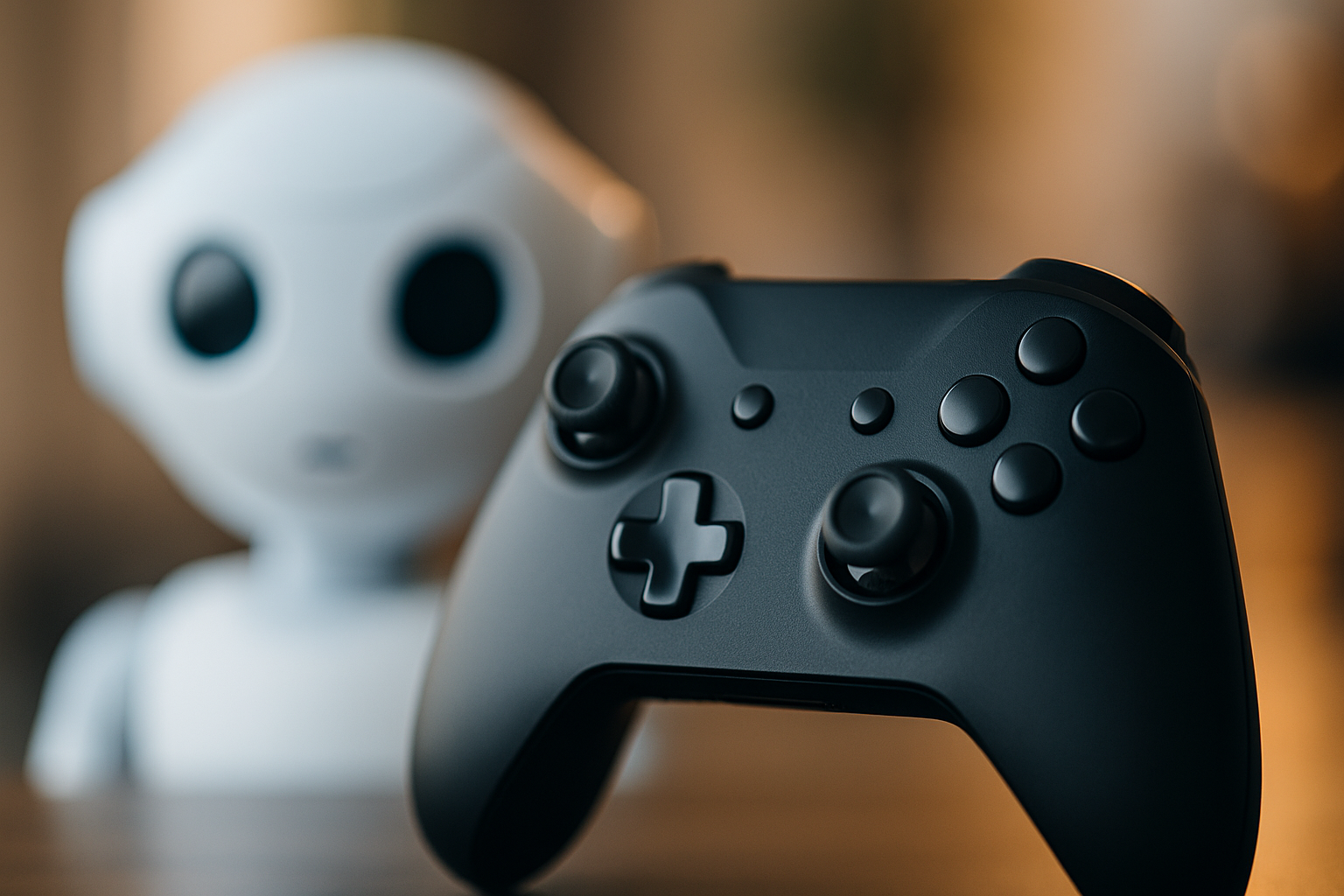
The explosion echoed through your headphones, and before you could process what happened, an NPC teammate called out a tactical suggestion you hadn’t considered. But here’s the twist – that wasn’t a human player. It was an AI so sophisticated that it read the battlefield, analyzed your playstyle, and adapted its strategy in real-time. This isn’t science fiction or a glimpse of gaming in 2030. It’s happening right now, and it’s fundamentally reshaping how we experience video games.
Artificial intelligence in gaming has evolved far beyond simple enemy patrol patterns and scripted responses. Today’s AI systems create dynamic narratives, generate entire worlds, and even challenge professional esports players with strategies humans never imagined. The gaming landscape is transforming at a pace that’s difficult to comprehend, and if you’re still thinking of game AI as those predictable enemies from classic arcade games, you’re missing a revolution that’s redefining interactive entertainment.
How Modern AI Creates Living, Breathing Game Worlds
Traditional game development used to mean manually placing every tree, scripting every conversation, and programming specific responses to player actions. Developers spent thousands of hours crafting content that players might experience for only a few minutes. AI has completely upended this model by introducing procedural generation systems that create unique content dynamically.
The difference between old and new approaches is staggering. Modern AI systems transforming gaming in 2025 can analyze player behavior patterns and adjust difficulty, pacing, and content in real-time. If you’re struggling with a particular boss fight, the AI might subtly reduce enemy aggression or provide additional resources. Conversely, if you’re breezing through challenges, it ramps up complexity to maintain engagement.
This adaptive approach extends to world-building itself. Some recent titles use machine learning algorithms to generate realistic terrain, populate cities with believable NPCs, and create side quests that feel handcrafted but are actually generated based on your playstyle preferences. The AI observes which types of missions you enjoy, what rewards motivate you, and even which narrative themes resonate most strongly, then crafts experiences tailored to those preferences.
What makes this particularly fascinating is the emergent behavior these systems produce. NPCs don’t just follow predetermined paths anymore. They have routines, relationships, and goals that evolve based on player actions and in-game events. Kill a shopkeeper in one part of the world, and their family members across the map might refuse to trade with you. Save a village from bandits, and you might encounter those same grateful villagers weeks later in a completely different context, remembering your heroism.
AI-Powered NPCs That Actually Feel Intelligent
Remember when video game characters would repeat the same three voice lines endlessly, or stand in place waiting for you to trigger their scripted dialogue? Those days are fading fast. Artificial intelligence is fundamentally reprogramming how NPCs function, moving from rigid scripts to dynamic, context-aware interactions.
The latest generation of AI-driven NPCs uses natural language processing to understand player intent rather than just recognizing keywords. You can have actual conversations where characters remember previous interactions, reference past events, and respond to the emotional tone of your choices. Ask an NPC about their family, and they’ll provide details. Return days later and ask about a specific family member they mentioned, and they’ll continue that conversation thread naturally.
Combat AI has evolved even more dramatically. Enemy characters now employ genuine tactics rather than just rushing toward you or taking cover in predetermined spots. They communicate with each other, coordinate flanking maneuvers, exploit your weaknesses, and adapt their strategies when initial approaches fail. Some games feature AI opponents that learn from player behavior across an entire community – when thousands of players employ a particular exploit or strategy, the AI evolves countermeasures that appear in everyone’s games.
Perhaps most impressively, AI companions have transformed from liability into genuine assets. Your AI-controlled teammates analyze battlefield conditions, manage their own resources, and make tactical decisions that complement your playstyle. They don’t just follow you around picking up items and occasionally shooting enemies. They position themselves strategically, provide covering fire when you’re vulnerable, and even sacrifice advantageous positions to support team objectives.
Procedural Content Generation at Unprecedented Scale
The promise of infinitely replayable games has existed for decades, but AI is finally delivering on that vision in meaningful ways. Procedural generation isn’t new – games have used algorithms to create random dungeons and levels since the 1980s. What’s changed is the sophistication and quality of AI-generated content.
Modern machine learning models can create content that doesn’t just feel random but intentionally designed. AI in game development is revolutionizing gameplay design by generating levels that maintain proper pacing, ensure players have access to necessary resources, and create memorable moments without human designers manually crafting every scenario.
Some games now use AI to generate entire storylines with branching narratives that respond to player choices in ways developers never explicitly programmed. The AI understands narrative structure, character development, and dramatic pacing well enough to create coherent stories on the fly. While these don’t always match the polish of hand-written narratives, the technology improves constantly, and the personalization creates experiences that feel uniquely yours.
The implications for game longevity are enormous. Instead of completing a 40-hour campaign and moving on, players can engage with AI-driven games for hundreds of hours, encountering fresh content throughout. This approach particularly benefits genres like roguelikes, survival games, and open-world adventures where repetition traditionally limits replayability.
Audio design has also benefited from AI generation. Some studios now use machine learning to create adaptive soundtracks that respond to gameplay intensity, emotional moments, and player actions. The music doesn’t just loop predetermined tracks – it composes variations in real-time, ensuring the audio landscape feels as dynamic as the visual experience.
The Rise of AI-Assisted Game Development
AI isn’t just changing how we play games but also how developers create them. The traditional game development pipeline involves massive teams working for years to produce AAA titles. AI tools are democratizing this process, enabling smaller studios and even solo developers to create experiences that previously required hundred-person teams.
Texture generation provides a perfect example. Creating high-resolution textures for every surface in a game world used to require armies of artists working for months. Now AI tools can generate photorealistic textures based on simple text descriptions or reference images. Developers can type “weathered brick wall with moss” and receive dozens of unique, game-ready textures in minutes.
Animation presents another area where AI delivers massive efficiency gains. Motion capture technology has long been the standard for realistic character movement, but it’s expensive and time-consuming. Machine learning models now generate natural-looking animations from simple inputs, interpolate between existing animations to create smooth transitions, and even predict appropriate reactions to environmental interactions without manual keyframing.
Quality assurance testing has historically been one of the most labor-intensive aspects of game development. Human testers must play through games repeatedly, trying to break systems and uncover bugs. AI testing bots can now play games thousands of times faster than humans, exploring edge cases and combination of actions that human testers might never attempt. They identify crashes, progression blockers, and balance issues with remarkable efficiency.
Voice acting is entering an interesting transitional phase. While nothing quite replaces talented human performers for main characters and critical narrative moments, AI voice synthesis has reached a quality level suitable for minor NPCs, background chatter, and procedurally generated dialogue. This allows developers to voice thousands of lines that would be cost-prohibitive using traditional methods, creating more immersive worlds where every character can speak rather than communicating through text boxes.
Personalized Gaming Experiences Through Machine Learning
The future of gaming isn’t one-size-fits-all experiences but personalized adventures tailored to individual preferences. Machine learning systems analyze how you play, what you enjoy, and where you struggle, then adjust the game to optimize your experience.
Difficulty balancing provides the most obvious application. Traditional games offer difficulty presets – easy, normal, hard – that affect enemy health, damage output, and resource availability uniformly across the entire experience. AI-driven dynamic difficulty adjustment operates with much more nuance. It might make combat slightly easier while maintaining puzzle complexity if you excel at problem-solving but struggle with action sequences. The adjustments happen gradually and subtly, maintaining challenge without creating frustration.
Content recommendation systems similar to those used by streaming services are appearing in games. Based on your play history, the AI might highlight quests you’ll likely enjoy, suggest character builds that match your preferences, or direct you toward areas of the game world containing content aligned with your interests. This curation helps players navigate massive open-world games without missing content they’d genuinely love.
Some multiplayer games use AI matchmaking systems that go far beyond simple skill ratings. These algorithms consider playstyle compatibility, communication preferences, and even personality factors to create teams that function well together. The goal isn’t just balanced matches but positive social experiences that keep players engaged with the community.
For those interested in streaming their gameplay, some platforms now offer AI tools that automatically identify highlight-worthy moments, create compilations, and even generate commentary. While not replacing human creativity, these tools help content creators spend more time actually playing and less time editing footage. Speaking of game streaming for beginners, these AI assistance tools are making it easier than ever to start sharing your gaming experiences.
The Competitive Gaming Revolution
Esports and competitive gaming face perhaps the most dramatic AI-driven transformation. Professional players have always studied opponents, analyzed strategies, and refined techniques to gain competitive edges. AI takes this analysis to levels humans simply cannot match.
Training AI has produced some startling results. Systems developed to master games like Dota 2 and StarCraft II have defeated world champion players using strategies no human ever considered. These aren’t just faster versions of human play – they represent genuinely novel approaches to game mechanics and tactics. Professional players now study AI matches to discover new strategies, much like chess grandmasters analyze computer games.
Practice tools leveraging AI provide enormous advantages. Instead of scheduling matches with human opponents of appropriate skill levels, players can train against AI that precisely mimics specific opponents’ playstyles, exposes weaknesses in their techniques, or drills particular scenarios repeatedly. The AI adapts in real-time, ensuring practice sessions remain challenging and productive.
Spectator experiences are improving through AI as well. Automated camera systems now track the action intelligently, ensuring viewers never miss critical moments even in chaotic team fights. AI commentators can provide real-time analysis of strategy and probability, while translation systems make international tournaments accessible to global audiences instantly.
The accessibility implications are profound. Players with disabilities benefit from AI assistance systems that can help with timing-critical inputs, provide alternative control schemes, or even play cooperatively with the human player. When evaluating different gaming setups, resources like our guide on choosing the right controller for your playstyle become even more relevant as AI-assisted controls expand the possibilities.
Cloud Gaming and AI: A Perfect Partnership
The convergence of cloud gaming and artificial intelligence creates possibilities neither technology could achieve alone. Cloud platforms possess the computational power to run sophisticated AI systems that would overwhelm local hardware, while AI optimizes the streaming experience to overcome traditional cloud gaming challenges.
Latency has always been cloud gaming’s Achilles heel. Even small delays between input and on-screen response ruin competitive experiences and feel awkward in single-player games. AI prediction systems now anticipate player inputs based on context and behavior patterns, pre-rendering likely scenarios to minimize perceived latency. The system might predict you’re about to turn a corner and pre-load that view, or anticipate a jump input based on your approach to an obstacle.
Bandwidth optimization benefits enormously from machine learning. AI analyzes your network conditions in real-time, dynamically adjusting stream quality to maintain smooth performance. During intense action sequences where responsiveness matters most, it might reduce visual quality slightly. During cutscenes or exploration, it maximizes visual fidelity. These adjustments happen seamlessly, often imperceptibly, prioritizing the aspects of quality that matter most in each moment.
For those exploring different services, understanding which cloud gaming services are worth it in 2025 requires considering their AI implementations, as these increasingly differentiate platforms beyond simple game library comparisons.
Server-side AI also enables experiences impossible on local hardware. Imagine massive multiplayer worlds where thousands of intelligent NPCs operate simultaneously, each with unique behaviors and goals. Or simulation games modeling complex systems with unprecedented detail. Cloud platforms can dedicate enormous computational resources to AI systems while streaming the results to modest devices, democratizing access to cutting-edge gaming experiences.
Looking Forward: The Next Frontier
We’re still in the early stages of AI’s gaming revolution. Current implementations, impressive as they are, represent primitive versions of what’s coming. The next decade will likely see developments that make today’s AI-enhanced games seem quaint by comparison.
Emotional intelligence represents one frontier. Future AI won’t just understand what players do but how they feel. Biometric sensors, voice analysis, and behavioral patterns could allow games to detect frustration, boredom, excitement, or fear, then adapt experiences accordingly. A horror game might ease tension if you’re genuinely terrified, or a puzzle game could provide hints when it detects frustration without you explicitly requesting help.
Cross-game learning presents intriguing possibilities. Imagine AI systems that remember your preferences, skills, and playstyles across different games, creating a persistent gaming profile that follows you everywhere. New games could immediately adjust to your skill level and preferences rather than requiring hours of tutorial content and difficulty calibration.
The creative partnership between humans and AI will deepen. Rather than AI replacing human developers, we’ll likely see collaborative workflows where humans provide creative vision and AI handles technical implementation. Designers might sketch rough level layouts that AI transforms into detailed, playable environments, or writers might outline story beats that AI expands into fully voiced, branching narratives.
Ethical considerations will become increasingly important. As AI systems become more sophisticated at predicting and influencing player behavior, questions about manipulation, addiction, and player welfare require careful consideration. The industry must balance creating engaging experiences with respecting player autonomy and wellbeing.
The transformation AI brings to gaming extends beyond better graphics or longer campaigns. It’s fundamentally changing the relationship between players and games, creating experiences that adapt, respond, and evolve in ways that feel genuinely alive. Whether you’re exploring vast open worlds, competing in intense multiplayer battles, or enjoying narrative adventures, AI is quietly revolutionizing every aspect of your experience. The future of gaming isn’t just about more powerful hardware or bigger budgets – it’s about smarter systems that understand players and create experiences tailored specifically for them. That future is arriving faster than most people realize, and it’s going to be extraordinary.

Leave a Reply